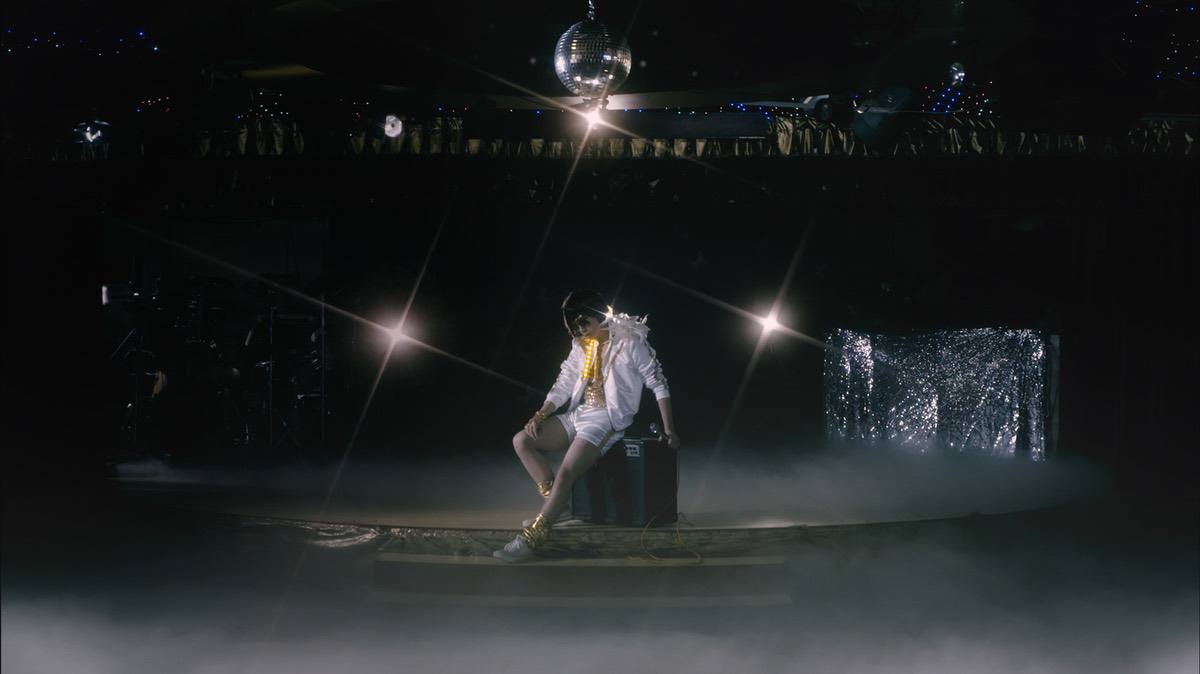
A Man After Midnight
The eponymous work A Man after Midnight was inspired by a photo in an early reference book on color-television technology. This work insinuates the variety show “Singing against the Wind” hosted by Frankie Kao (Kao Ling-Feng) between 1980 and 1983. This photo rekindled Su’s memory of this Saturday night show of the moment. This variety show was a rare spectacle at a time for its magnificent lighting wall and overwhelming dancer troupe, alongside two groups of chorus and an exclusive orchestra composed of a dozen members. Kao not only hosted the show, but also took charge of singing, dancing and playlet. It was not only the peak of Kao’s career in the 1980s but also su hui-yu’s most vivid childhood memory of Saturday nights. As one of the pioneering performers who emulated the Western disco style, Kao not only introduced a new form of pop music to Taiwan by adapting and covering Western songs, but also endorsed the straightforward, undisguised lust and corporality embedded in disco music. Nonetheless, Kao’s songs failed to pass the cultural censorship from time to time, since Taiwanese society was still under martial law in the early 1980s, an age when entertainment was demanded to be enlightening. The magnificent spectacle of Kao’s early variety show served as a stark contrast to the miserable twilight years of his stage career,_ which is exactly the kernel image that the artist attempts to convey through the work A Man after Midnight(After the show “Singing against the Wind” ended its run, Frankie Kao was entangled in mafia circles, being prisoned for illegal possession of firearms, and ergo suffered a force-out by television companies. What made his situation worse was that the cabarets he invested in were either closed down or proscribed by formal decree during the late 1990s. After a fifteen-year break-off, Kao resumed his stage career with political cosplay.). Su replaced the scene in this work with that of the only remaining red envelop club in Ximending — The Phoenix Grand Cabaret, and provided the instrumental accompaniment of Kao’s hit song The Annoying Autumn Winds. This song was adapted from the best-selling single Gimme! Gimme! Gimme! (A Man after Midnight) released by the popular Swedish band ABBA in 1979. The original lyrics depicted a woman who watched television for most of the night, expecting an ideal man to come out of the world of fantasy from the television and take her away from the suffocating reality. In Kao’s adapted version, the lyrics were modified to represent the call of a man to his lover who has gone away. What remains in the coda of this video are the instrumental accompaniment and the frustrated singer who seems disoriented on a step chair as if living in another parallel universe. 《臨風高歌》的靈感來自於一本早年關於彩色電視技術的工具書內的一張照片,展示著1980-83年間藝人高凌風所主持的同名綜藝節目。這張照片勾起了蘇匯宇的回憶。這個當年打造紅極一時的週六晚間節目,有著當代少見的排場:燈光牆、舞群、兩組合音天使,以及十多位成員組成的華視大樂隊。高